Why Commercial Performance and People Performance Aren't Separate Problems
The short answer
Make Growth Work is Suzie Thompson's model for sustainable growth: commercial growth, organisation and people, and execution, aligned rather than treated as separate problems. When growth stalls, most organisations reach for a commercial fix: more salespeople, more activity, a new CRM. Often the real problem sits in roles, structure or culture, and the commercial fix makes it worse.
I've spent 25 years with P&L responsibility, leading sales, marketing and commercial functions and redesigning the teams around them. The biggest gains I've seen have rarely come from selling harder. They've come from changing how people work together so that selling gets easier.
What happens when growth is treated as only a commercial problem?
It often gets worse. I saw this clearly early in my career at a media company selling advertising.
The growth plan was simple: more sales activity and more CRM data. Company-wide league tables ranked everyone on calls, activity and opportunities logged. They were meant to motivate. They did the opposite.
The real problem was structural. Salespeople closed a deal and then handled the production copy themselves, chasing clients for wording, briefing the designers and managing the redesigns. That took hours away from building long-term client relationships. With fewer long-term campaigns booked, there was always unsold space close to deadline. So everyone in the office ended up selling small ad spaces very cheaply at the last minute, which undercut the longer-term selling even further. It was a vicious cycle.
The fix wasn't more selling. It was a new role. We introduced sales administration and set up the CRM properly, for the whole workflow rather than just sales data. As soon as a campaign was confirmed, sales admin was notified automatically and picked up the copy, the chasing and the redesigns.
Three things changed:
-
Salespeople got hours back to spend on long-term, higher-value, more profitable relationships.
-
The CRM data got cleaner, because using it now saved people time instead of feeding a league table.
-
Late space still sold, but through the right people. Sales admin built their own relationships with clients, so they could place late space without dragging the sales team away from bigger deals.
Nothing about that fix was a sales technique. It was role design, process and trust in a system, and it lifted commercial performance more than any league table did.
What is Make Growth Work?
Make Growth Work looks at growth through three overlapping areas. Sustainable performance sits where all three meet.
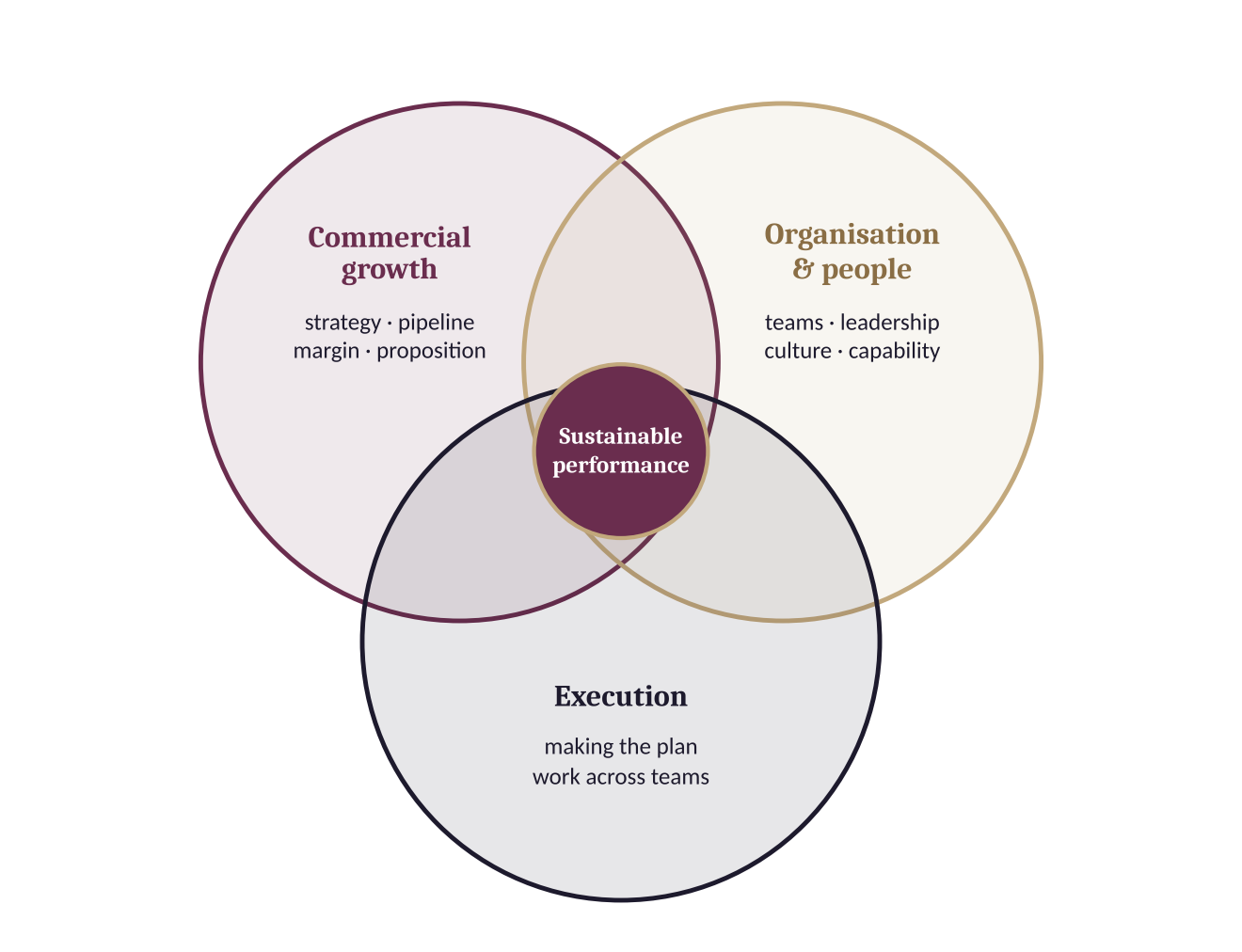
| Area | What it covers | What goes wrong without it |
|---|---|---|
| Commercial growth | Growth strategy, sales effectiveness, client strategy, proposition, pricing, margin and pipeline. | Activity without direction. The team is busy, but revenue stays unpredictable. |
| Organisation and people | Team design, roles, leadership, culture, employee voice, capability and change. | A strategy the organisation isn't built to deliver. |
| Execution | Taking what's on a slide, or in the CEO's head, and making it work across teams every day. | Plans that live in the deck, not the diary. |
A pure commercial leader may fix the sales process. An organisation development specialist may redesign the structure. A people leader may focus on capability and culture. Each is valuable, but on their own they leave a gap. Most growth problems need all three looked at together.
What does it look like in practice?
Here are three examples from my own work, each one a commercial result that depended on people and structure.
Merging sales and marketing into one team
In one organisation I worked with, sales and marketing sat in separate teams. Campaign messages and sales conversations didn't always line up, and the two teams weren't always pulling in the same direction. The business also needed to be more agile.
My belief is that sales and marketing are the same team. Both are front line, both shape how the brand is seen, and each feeds the other, insight included. So we merged them into one commercial function.
The commercial case was clear, and everyone understood the benefits. What people worried about was each other. So everyone had a say, and people suggested what the roles should look like. Some roles stayed the same, some changed slightly, some changed a lot, and a small number didn't continue. I was in every one of those conversations. I led them with kindness, had the difficult conversations myself, and supported people through them, including helping them find other roles. Then we invested a lot of time in the new team.
Operations and design were in the room too, even though their own roles weren't changing. The wider message was that everyone is part of sales and commercial, because everyone has touch points with clients and a view of where the organisation is heading.
A margin calculator that changed behaviour, not just prices
Pricing is another place this shows up. In one business, commercial thinking wasn't yet part of everyday decisions. Salespeople fitted the solution to whatever the client's budget was, so margins were shrinking, especially on tailored work. Discounting was easy, and approvals, particularly for bids, took far too long.
We built a margin calculator with a red, amber and green approval process. The important part was how we built it. Every function was involved, including delivery and finance, because we needed every stage and touch point to find the hidden costs. Delivery then used it to see how much design time each piece of work had, with a trigger that flagged scope creep before it happened.
Margins on new clients improved straight away, and the gains spread across existing clients over time. It was a commercial tool, but it only worked because every team helped build it and every team used it.
Lifting client retention by 55%
In another organisation, a global business I worked with on an interim basis, client retention rose by 55% and average client spend by 15%.
The commercial changes mattered: client segmentation, and crib sheets that gave the team the wider context of each account, where it could grow, and where it could expand. But the bigger change was structural. We made roles clear and shared account custodianship. Sales were no longer only brought in at renewal for what clients heard as “can we have your money?”. They kept a relationship running all year.
Clear roles also gave the membership and design teams more time to focus on delivery and the impact of the programmes, including expanding the portfolio. And because it happened during a restructure done at pace, we held lots of one-to-ones and shared the full story of why, so people understood the change rather than just experiencing it.
How do you tell if a growth problem is really a people problem?
Look beneath the number. The same pattern shows up in every sector: a commercial symptom with a structural cause. The figures below are illustrative.
| Sector | What it looks like | What's often underneath | What tends to fix it |
|---|---|---|---|
| Architecture practice | Average fee per project down 20% as more work goes to competitive tender. | Directors win the work, but project architects only see it after the scope and fee are set, so jobs are underpriced. | Bring project leads into scoping and pricing before the fee is agreed. |
| Wealth management | New client money falls from £40m to £24m a year. | Advisers are measured only on the assets they manage, so nobody asks happy clients for introductions. | Shared introduction targets and a referral process across advisers and client service. |
| Hotel group | Corporate bookings down 30%, with rooms filled through discounted online channels. | Sales and revenue management set prices separately, so sales can't agree a corporate rate quickly. | One pricing team, with clear rate authority for sales. |
| Logistics and freight | The five largest customers now make up 70% of revenue. | Account managers spend their days firefighting delivery problems, with no time to grow mid-sized accounts. | Operations owns service issues; account managers own growth. |
| Managed IT services | One in five clients leaves at renewal. | The service desk sees the problems months before account managers do, but nobody connects the two. | A monthly client review shared by the service and account teams. |
| Professional services | Bid win rate falls from 35% to 22%. | Partners write bids alone and have to demand input; nobody owns the client between projects. | Named client owners, to build relationships outside and part of the bid process, and a shared bid process with delivery. |
If the fix in the right-hand column is a role, a process or a way of working together, it's a Make Growth Work problem, not a sales problem.
How to use Make Growth Work
Ask three questions of any growth plan. Where an answer is weak is where growth will leak.
-
Commercial: is it clear how this plan makes money, and at what margin? If the plan shows revenue but not margin, or a target but not the route to it, start here.
-
Organisation and people: are the teams, roles, skills and culture set up to deliver it? Who owns the client? Who is measured on what? What happens at each handover?
-
Execution: will it survive Monday morning? Who will do what differently, starting when, and how will you know?
A growth plan that answers all three well rarely needs more selling. A plan that only answers the first is usually the one asking the team to work harder.
Frequently asked questions
What is Make Growth Work?
Make Growth Work is Suzie Thompson's model for sustainable growth. It aligns three areas that are usually managed separately: commercial growth, organisation and people, and execution.
Why doesn't more sales activity fix a revenue problem?
Once everything is in place it can. But quite often the cause is structural: unclear roles, poor handovers, or salespeople spending time on work that isn't selling. More activity on top of a broken structure usually adds pressure without adding revenue.
Should sales and marketing be one team?
In my view, yes. Both are front line, both shape how the brand is seen, and each feeds the other with insight. Whether or not they share a reporting line, they need shared messages, shared definitions and shared goals.
How do you restructure a commercial team without losing people's trust?
Give everyone a voice in what the roles should look like, share the full reason for the change, deliver difficult outcomes personally and kindly, and support the people affected, including into new roles elsewhere. Then invest time in the new team.
Is this only for large organisations?
No. It matters most in organisations of around 50 to 200 people, where a handful of individuals often carry the commercial relationships and one structural change can shift results quickly.
Where to go from here
If your growth plan is asking people to work harder while the results stay flat, the answer is probably not another commercial push. Look at who owns the client, what happens at each handover, and whether your teams are pulling in the same direction.
This is the work I do, as a non-executive director of ODN Europe, where a new tiering model and year-round engagement helped grow membership by 125%, and with the organisations I work with. If you'd like an outside view of where growth is leaking in yours, book a conversation. The first one costs nothing.
Related reading:
- The Four Anchors: how to tell a real deal from a hopeful one
- Why more sales activity isn't fixing your revenue problem
- How to build a sales enablement strategy that actually works
Suzie Thompson helps organisations make growth work, aligning commercial strategy, people and execution so ambition turns into sustainable performance. She has 20+ years of P&L ownership, an ILM Level 5 coaching qualification, and is a non-executive director of ODN Europe.