The 3 Cs of Strategic Networking: Clients, Collaborators and Champions
The short answer
The 3 Cs of strategic networking are Clients, Collaborators and Champions: three kinds of relationship that turn connection into commercial growth. Clients are the people you serve. Collaborators are the people you build with. Champions are the people who talk about you when you're not in the room. A strategic network invests in all three on purpose, rather than collecting as many contacts as possible.
When I started out in advertising, we judged a networking event by how many business cards we came home with. That was wrong. A pocket full of cards from people who'll never think of you again is activity, not growth. Since then, I've won contracts, partnerships and promotions through relationships, and almost none of them came from a room where I was trying to meet everyone.
What are the 3 Cs?
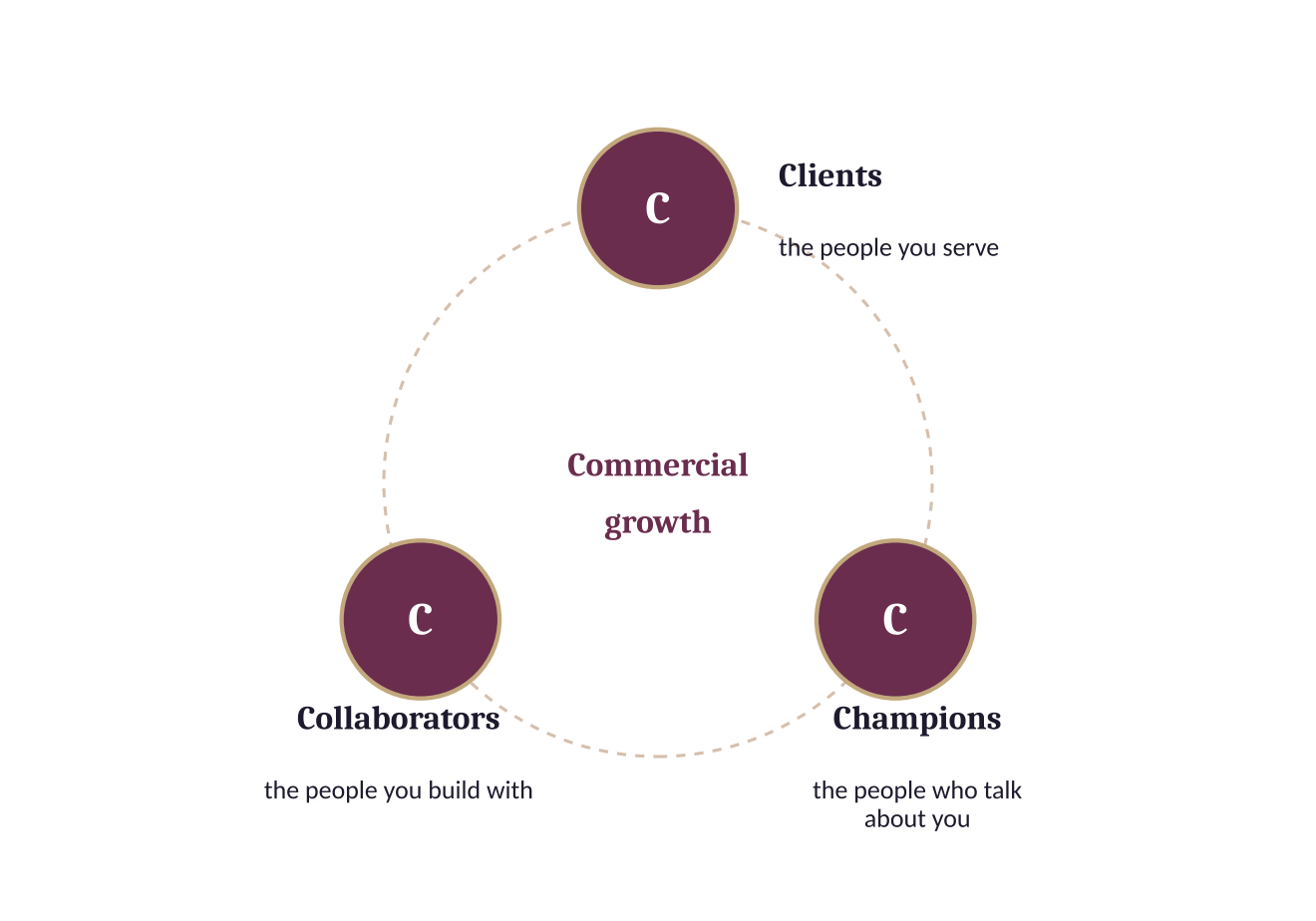
| Relationship | Who they are | What they give you | How to look after them |
|---|---|---|---|
| Clients | The people and organisations you serve, now or in future. Some of today's networking contacts are tomorrow's clients. | Revenue, proof that your work delivers, and often your best referrals. | Show up where they learn, not just where they buy. Be known for solving their problems. |
| Collaborators | Peers, partners and complementary businesses who serve the same people in a different way. Sometimes even competitors. | Reach, capability you don't have, and work you couldn't win alone. | Look for shared clients and shared goals. Co-create offers, events or content. Swap introductions. |
| Champions | People who recommend you when you're not in the room: former bosses, clients, peers, advisers. | Trust you haven't had to earn yourself. Their name opens doors yours can't. | Keep them informed. Thank them, publicly and privately. Make it easy for them to describe what you do. |
Why are champions so valuable?
Because trust transfers. When someone a buyer already trusts recommends you, you skip months of proving yourself.
When I was at Bolney Wine Estate, a wealth management adviser introduced us to one of their clients, a technology company looking for corporate gifts. Without that introduction we would almost certainly never have been on their radar. They trusted their adviser, so they trusted us, and we won an order to supply corporate gifts to more than 300 of their team.
Champions can shape a career too. Tony Portelli, a former leader of mine, believed in me before I fully believed in myself. He developed me into a stronger leader, backed me for promotions, and when he moved to a different company, he brought me into a new role there. That's what a champion does: they put their own reputation behind yours.
This is the whole idea behind networks like BNI: members talk about each other when they're not in the room. It suits me because I naturally help and recommend people. And the more you champion others, the more people champion you back.
How do collaborators help you win work?
They let you offer more than you could on your own, and they send you work you'd never have found.
At a leadership development business, we partnered with Immersive Edge, who create excellent simulations on culture and change. It was a genuinely two-way partnership. Their simulations added to what we could offer clients, so we won work we couldn't have won alone, including a major contract where a simulation was a core part of the solution. And it worked the other way too: when their simulations uncovered development needs, they didn't provide themselves, they brought those leads to us.
Collaborators can even be competitors. Back in advertising, we worked with a local radio station on community events and projects. They were one of our biggest competitors for advertising budgets. But together we made the offer stronger and the impact bigger for our clients, and our clients noticed.
The test for a good collaborator: do you serve the same people, in a different way, with the same standards?
Where do clients fit into networking?
In two ways. First, some of the people you meet through networking will become clients, as long as you treat them as people first and prospects second. Second, clients you've already worked with are often your best source of new ones.
Most of my consultancy work today comes through people I've worked with before, and through people I've met in my co-chair role at ODN Europe. Very little comes from a cold enquiry. It came from people who'd seen, and felt, how I work.
At Bolney Wine Estate, when we moved to online tastings and gifting during Covid, one client sent a gift to one of their own customers. That customer liked it so much that our client introduced them to us, because they wanted something similar. Happy clients don’t just buy again; they can do the selling for you.
Online or offline: where should you network?
Both, for different reasons. Online builds credibility. Offline builds trust. People find you online, then decide whether you're worth meeting.
Online: specific beats popular
One of my posts that started the most conversations was about feedback. After a psychometric assessment for an executive role (one I went on to secure), I was told I had “a Rolls-Royce brain in a Ford chassis”. The point of the post was that feedback like that isn't useful. Feedback should be constructive, and that wasn't. People recognised it, and they wanted to talk.
But the posts that actually bring me work are much quieter. They're the very specific ones about things I see and deliver in my work. Some fight to reach even 100 views, far fewer than my stand-out posts. Yet they're the ones that bring profile views, new followers and visits to my website. Vanity metrics are good for confidence. They're not good for conversion.
A smaller, more specific net often brings a better catch.
Offline: choose your rooms
The rooms that work for me when I am looking to build clients and champions are BNI and events that meet weekly, because they give time for building relationships and reward people who naturally recommend others. Membership organisations are also great because everyone shares a common interest. I’ll go to events where the aim is to get as many people into the room as possible when I am looking for potential collaborators because you never know who will be there and who they know. It also helps me build champions as my network is varied so I can often help a lot of different people via introductions, and when that happens they often want to help you in return.
It is a choice about fit, not a rule. The right room depends on who you serve.
Who should be in your 3 Cs?
It depends on your business. Here's how the 3 Cs and the best rooms might look in different sectors (illustrative examples):
| Business | Likely champions | Likely collaborators | Rooms worth your time |
|---|---|---|---|
| Accountancy practice | Bank relationship managers and solicitors who see clients at key moments | Business coaches and bookkeepers serving the same owners | Local business breakfast clubs; industry association events for your niche |
| HR consultancy | Employment lawyers and finance directors who hear about people problems first | Recruiters and learning providers | HR director roundtables; membership bodies for people professionals |
| Artisan food or drink producer | Delicatessen owners and event caterers who recommend suppliers | Gift box companies and local venues | Trade shows for buyers; regional food networks |
| Wedding and events venue | Wedding planners and photographers whose couples trust them | Florists, caterers and bands | Wedding fairs; supplier showcases at partner venues |
| Software start-up | Early customers and investors with networks in your market | Implementation partners and complementary software firms | Sector-specific meetups; online communities where your users ask questions |
| Interior design studio | Estate agents and architects who meet clients before a project | Builders and furniture makers | Property and design shows; small invitation-only client events |
| Executive coach | Former clients now in senior roles; HR leaders | Leadership trainers and organisation development consultants | Small leadership dinners; professional membership networks |
The pattern: champions meet your clients before you do. Collaborators serve them alongside you. Map both before you book another event.
How do you put the 3 Cs into practice?
With a short plan you review every quarter. Here's a starting point:
| Connection | This quarter | What it builds |
|---|---|---|
| Clients | Reconnect with your top five clients. Ask for two testimonials. Share one success story. | Loyalty and referrals |
| Collaborators | Plan one joint event or piece of content. Make three introductions between people in your network. | Reach and shared visibility |
| Champions | Send three personal updates on what you're working on. Publicly thank one person who's helped you. | Advocacy when you're not in the room |
Review it every quarter. Keep what's working, change what isn't, and repeat.
What if networking fills you with dread?
You're not alone. Many people avoid networking because they think they have to sell, or present themselves in a certain way. When I work with nervous clients, I help them change the story they tell themselves. You're going to meet new people, with no agenda. Be curious. Curiosity is the best networking technique there is anyway.
But if you're going to go to an event and stand in the corner without speaking to anyone, don't go. Start online instead. Comment thoughtfully on posts from people you'd like to know, then move the conversation to a message, then a call. You can build a good part of your 3 Cs before you ever walk into a room.
Frequently asked questions
What are the 3 Cs of strategic networking?
The 3 Cs are Clients, Collaborators and Champions: three kinds of relationship that turn connection into commercial growth. The framework is by Suzie Thompson.
What's the difference between a collaborator and a champion?
A collaborator works alongside you, serving the same clients in a different way. A champion recommends you to others. Some people are both.
Is BNI worth it?
It depends on you and your business. Structured referral networks like BNI work best for people who enjoy recommending others and whose clients are local or relationship-driven. It also works well for people that don’t like networking or selling themselves directly – once you get over the first couple of meetings you build strong relationships that can bring more than business benefits.
How do I measure whether networking is working?
Not by business cards or followers. Track introductions made, conversations that led to meetings, collaborations started and work won through referral. A few strong relationships beat a large, quiet network.
I'm an introvert. Do I have to go to events?
No. Start online, where you can be thoughtful and consistent, and choose small rooms over big ones when you do meet in person.
Where to go from here
Networking works when it's intentional: the right people, in the right rooms, for the right reasons. Start by naming three champions, three collaborators and the clients you'd most like to work with again. Then make it easy for each of them to remember, refer and recommend you.
If you'd like a practical toolkit, download my free guide, Strategic Networking for Commercial Growth, from the Downloads page. It includes a networking portfolio map and the quarterly plan. And if you'd like to talk about how relationships could drive growth in your business, book a conversation.
Read next: Why commercial performance and people performance aren’t separate problems and The Four Anchors: How to Tell a Real Deal from a Hopeful One.
Suzie Thompson helps organisations make growth work, aligning commercial strategy, people and execution so ambition turns into sustainable performance. She has 25+ years of P&L ownership and is co-chair and a non-executive director of ODN Europe.
Suzie Thompson, commercial and organisational growth consultant. 25+ years of P&L ownership. West Sussex and London.